Romance and AI
How to Tell If Someone Online Is Real or AI (Fake Love, Deepfakes & Chat Scams)
How to tell if someone online is real or AI: reverse image search, AI photo checks, live video tests, romance-scam red flags, and safe next steps.
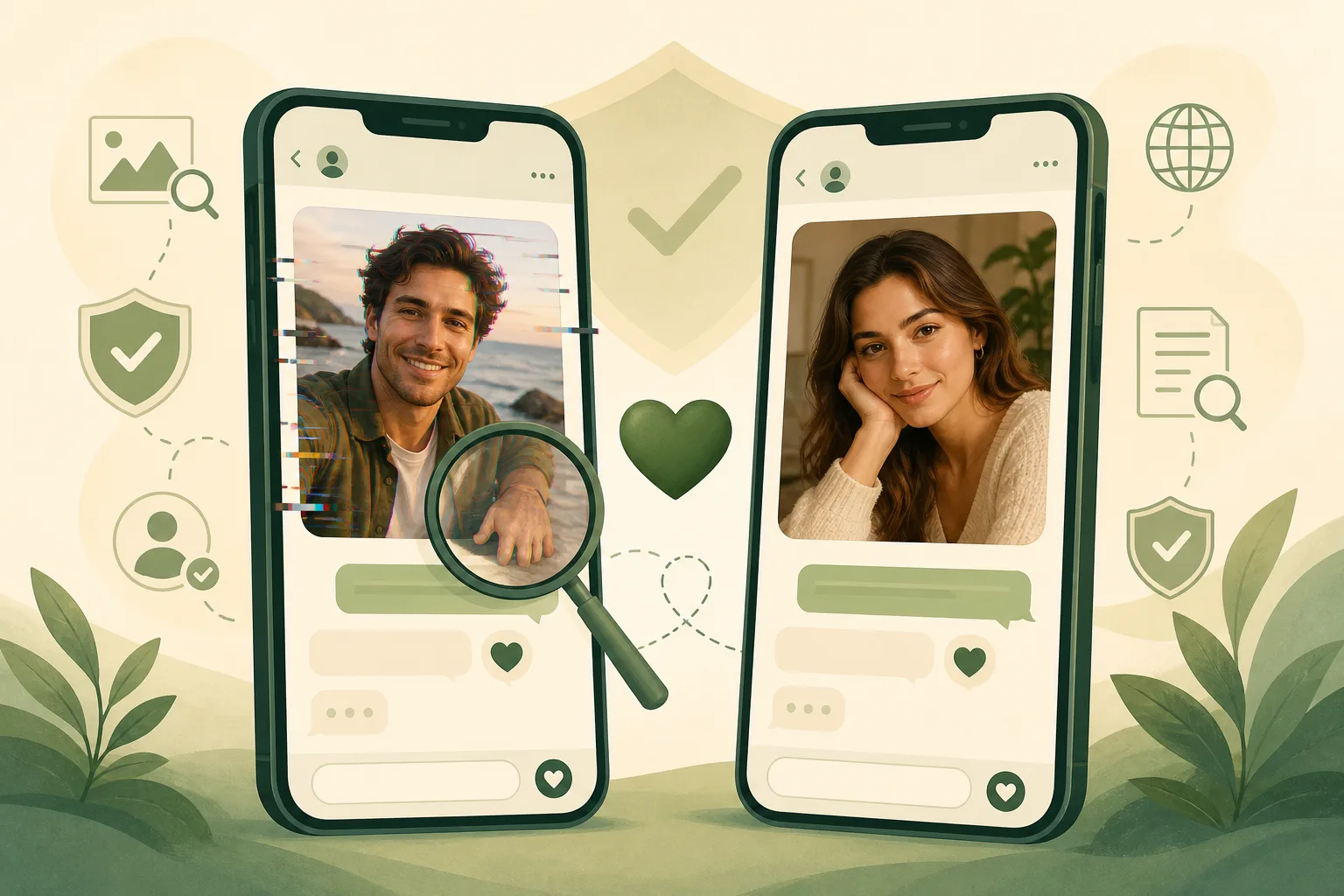
Short answer: If you need to know whether someone online is real or AI (or a fake romance persona), do not trust a perfect photo or sweet voice note alone. Run reverse image search, check for AI-generated pictures, demand a simple live video proof, and watch for psychological pressure. If they avoid verification and rush money, treat them as fake until proven real.
Falling for someone through a screen is not foolish. It is human. Scammers know that. In modern online love scams, the “person” may be a stolen identity, an AI-generated face, a chatbot script, a voice clone, or a mix of all four. The feelings can be real on your side. The profile on their side may not be.
This long guide shows you how to tell if someone online is real or AI — including fake love profiles, deepfakes, and chat scams — with tools, psychology, and a routine you can reuse on dating apps, WhatsApp, Telegram, Discord, Instagram DMs, and “too perfect” friend requests.
Why “someone you love online” is hard to verify now
Older catfishing usually meant stolen photos. Today’s kits can include:
- AI-generated faces that never belonged to a real public person
- Face-swap video during a call
- Cloned voices for panic or romance
- Chat assistants that keep replies warm 24/7
- Fake “proof” documents and staged workplaces
So the question is no longer only “Are the photos stolen?” It is: Is this identity a real human relationship — or a production?
90-second checklist: real love interest or fake persona?
Do these before you share private details, intimate photos, ID, or money:
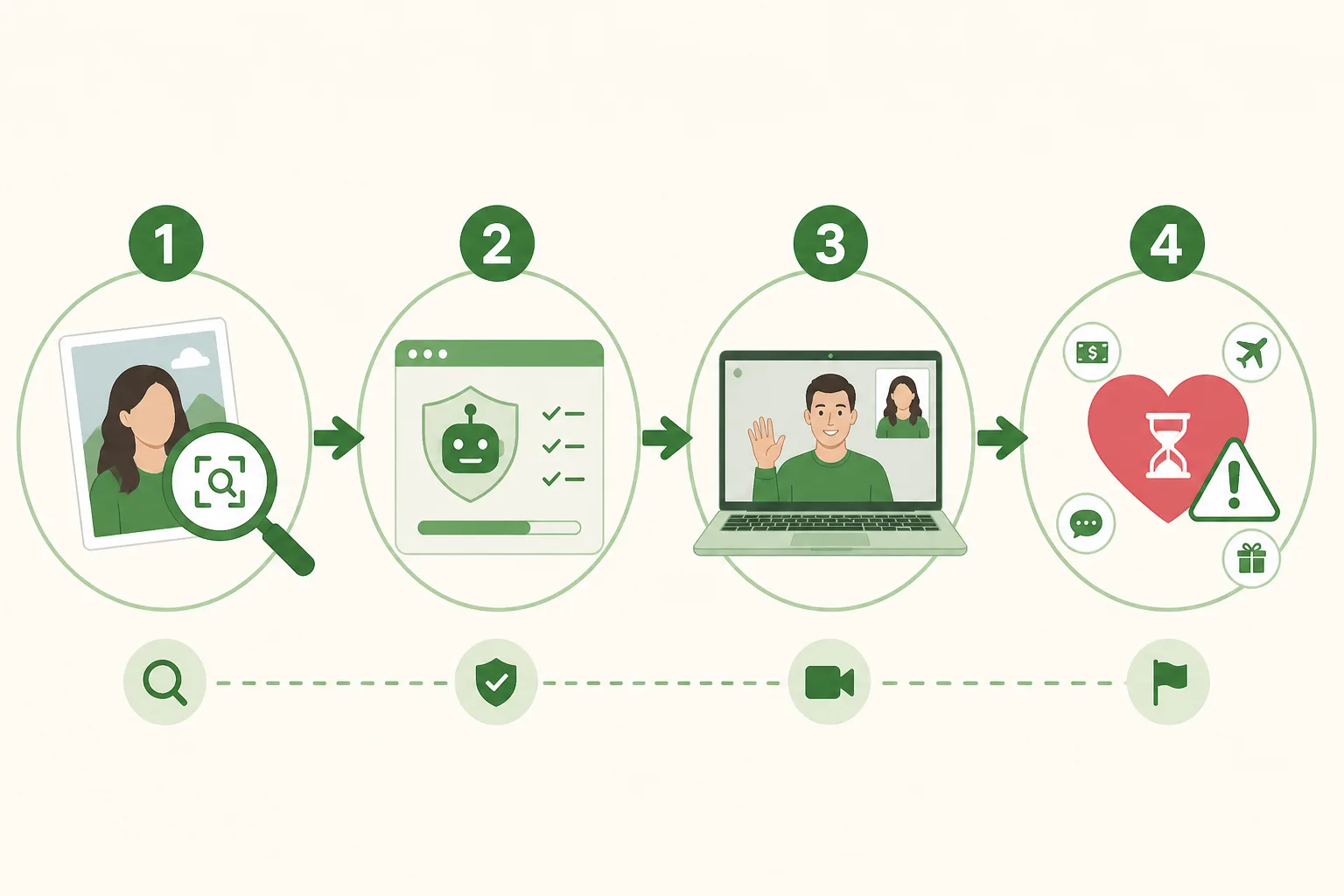
- Reverse-search their best photos (Google Images / Lens and TinEye).
- Inspect for AI-image tells and optionally run an AI photo detector.
- Ask for a live video call with movement (turn head, wave, show room briefly).
- Request a fresh proof clip: handwritten date + a random object you name.
- Test consistency across days (job, city, schedule, family details).
- Watch for money + urgency + secrecy — the usual endgame.
- Never pay to prove love, unlock a visit, clear customs, or “hold a ticket.”
If steps 1–3 already fail, stop. You do not owe a stranger unlimited trust because the chat feels intimate.
Technique 1: Reverse image search (still the highest-ROI move)
Reverse image search is how many people discover that someone they love online is fake within minutes.
How to do it well
- Save the clearest face photo and 2–3 lifestyle shots.
- Search with Google Images / Google Lens and TinEye.
- Search cropped faces and full scenes (beaches, cars, uniforms travel well in scam kits).
- Check older photos too — scammers rotate albums.
How to read the results
- Same face on many dating/social profiles → stolen identity kit → Exit
- Same photos on a model/creator page → stolen from a real person → Exit
- News or stock-photo hits → fabricated persona → Exit
- No matches → inconclusive → Keep testing
- Near-duplicates with warped details → possible AI generation → Dig deeper
No match does not mean safe. Some AI faces and private stolen albums leave little public trail. Reverse search is step one, not a free pass.
Technique 2: Spot AI photos with your eyes + detectors
AI image detectors estimate whether a picture was generated or heavily edited. They help, but they are imperfect. Use them as a second opinion.
Visual AI artifacts people miss
- Hands, fingers, rings, or nails that look wrong
- Teeth or earrings that do not match across photos
- Hair melting into backgrounds
- Background signs/text that almost make sense
- Glasses reflections / pupils that look uneven
- Skin that is too plastic, pores missing, “influencer lighting” in every shot
- Body proportions that shift from photo to photo
Detector workflow
- Run 2–3 photos through more than one reputable detector if possible.
- Compare scores — disagreement means “slow down,” not “ignore.”
- Ask for a new selfie that cannot come from an album:
- handwritten date of today
- a random object you choose (“two spoons and a blue mug”)
- spoken random phrase on video (“yellow bicycle 19”)
Stolen albums and static AI packs struggle with fresh, specific proof.
Technique 3: Live video and voice checks (harder to fake)
Photos are cheap. Live presence is harder — though deepfakes are improving, many operators still fail basic challenges.
Strong verification prompts
- Unscheduled video call (not a rehearsed evening slot only)
- “Turn left, turn right, stand up, show the ceiling briefly”
- “Hold your phone to a mirror for two seconds”
- “Say this exact sentence…” (you invent it live)
- Compare live voice to old voice notes (accent, breath, pacing)
Weak setups that should worry you
- Camera is “always broken”
- Only pre-recorded clips or dark frozen video
- Face barely moves when talking
- They refuse movement tasks
- Call quality collapses only when you ask for proof
- They switch to “just send help, I’ll video later”
If they can write love letters for hours but cannot do a 20-second live check, believe the refusal.
For panic calls that sound like family, use a callback + code word routine — full guide: AI Voice Clone Scams.
Technique 4: Psychological techniques scammers use on people in love
Most fake “AI people” online are not fully autonomous robots. They are systems: human operators + AI tools + emotional scripts. The psychology is often clearer than the pixels.
1. Love bombing
Intense affection early. Future-faking (“I already told my sister about you”). Speed replaces courtship.
2. Isolation
“Let’s move to WhatsApp/Telegram so we can be closer.” Off-platform chat reduces reporting tools and third-party friction.
3. Idealization + intermittent reward
Hot attention, then sudden coolness, then a grand apology. That intermittent pattern can deepen attachment fast.
4. Manufactured crisis
Hospital holds, military paperwork, customs fees, business seizures — always solvable by your money, today.
5. Sunk-cost pressure
“After everything we’ve shared…” Your time investment becomes their leverage.
6. Secrecy framing
“Don’t tell your friends yet — they won’t understand us.” Secrecy protects the scam.
7. Offense as a weapon
Verification is twisted into “You don’t love me.” Real partners who want a real future can survive a reverse image search.
8. Authority cosplay
Fake HR, fake lawyers, fake doctors on the same chat thread. Multiple characters, one operator.
Technique 5: Chat patterns that expose bots and scripts
AI writing helpers and copy-paste kits leave traces:
- Overly polished, essay-like replies to simple texts
- Emotional language with almost no checkable local detail
- Avoidance of specifics you can verify (employer, neighborhood, schedule)
- Time-zone contradictions
- Story arcs that match common romance or job-scam templates
- Rapid pivot to payment rails (crypto, gift cards, deposit links)
If the “relationship” starts resembling a remote job scam (tasks, dashboards, withdrawal fees), compare Telegram remote job scam guide. For classic relationship fraud stages, see Romance scams online.
Technique 6: Cross-check life outside the chat
A real person usually leaves a messy, verifiable trail.
Ask (and verify yourself):
- Does their claimed workplace or school exist on official sites?
- Do mutual friends exist in a way you can confirm without their coaching?
- Does their “company email” match a real domain you typed yourself?
- Are they asking for ID/passport copies unusually early?
Sending identity documents to a chat romance is high risk. Copies can be reused for fraud accounts and fake KYC. Worrying is rational.
Also keep passwords and login links out of the love chat. If a “partner” sends you to a login page, use the habits in How to tell if a website is safe.
Real vs fake: side-by-side
Photos
- More likely real: imperfect, consistent over time
- More likely fake / AI-assisted: too perfect, shifting details, reverse-search hits
Video
- More likely real: willing, flexible, responds live
- More likely fake / AI-assisted: avoids, freezes, refuses challenges
Pace
- More likely real: normal ups and downs
- More likely fake / AI-assisted: instant soulmate intensity
Money
- More likely real: not required to continue the bond
- More likely fake / AI-assisted: urgent fees, gifts, crypto, travel deposits
Conflict
- More likely real: can discuss boundaries
- More likely fake / AI-assisted: shame, anger, or silence when verified
Identity
- More likely real: checkable life details
- More likely fake / AI-assisted: fog, contradictions, coached answers
A 7-day slow-trust plan (if you still want to continue)
Use this when feelings are strong but proof is incomplete:
Day 1–2: Reverse-search all photos; no money; no ID.
Day 3: Live video with movement + random phrase.
Day 4: Consistency quiz on earlier details.
Day 5: Light public footprint check (without stalking extremes).
Day 6: Tell a trusted friend the story out loud — notice what sounds off.
Day 7: Decide: continue slowly, or exit.
Scam scripts hate structured delay. Real connections can survive it.
What to do if you already sent money or intimate content
- Stop all payments immediately.
- Preserve chats, usernames, wallets, receipts, and profile URLs.
- Contact your bank/payment provider fraud team.
- Report through reportfraud.ftc.gov and the platform.
- Ignore “recovery agents” who message next — often a second scam.
- If intimate images were shared, use platform reporting tools and local guidance for image-based abuse where available.
- Talk to someone safe. Shame helps scammers; support helps you.
Quick answers
FAQ
7 questions
Reverse search photos, request a live proof video with today’s date and a random object, and refuse any money request during that hour. That trio catches a large share of cases.
Trusted sources
- FTC: how to avoid a scam
- FTC: romance scams
- FTC: scammers use AI in family emergency schemes
- CISA: phishing guidance
- Report fraud to the FTC
Key takeaways
- To tell if someone you love online is real or fake, use a checklist: reverse image search, AI-photo review, live video proof, and psychology red flags.
- Perfect photos are not proof of a real partner.
- AI detectors help, but behavior under verification matters more.
- Love bombing, secrecy, sunk cost, and sudden fees are classic scam psychology.
- Real connection survives daylight. Fake personas punish questions and demand payment.
Was this guide helpful?
Tap like or dislike — one vote per visitor.
Comments
Share a tip or question. Keep it practical — no spam, links farm, or personal data dumps.
- Loading comments…