Education guide
Romance Scams Online: How They Work and How to Avoid Them
Learn how online romance scams build trust, move you off-platform, and request money — with a virtual scenario and a clear protection checklist.
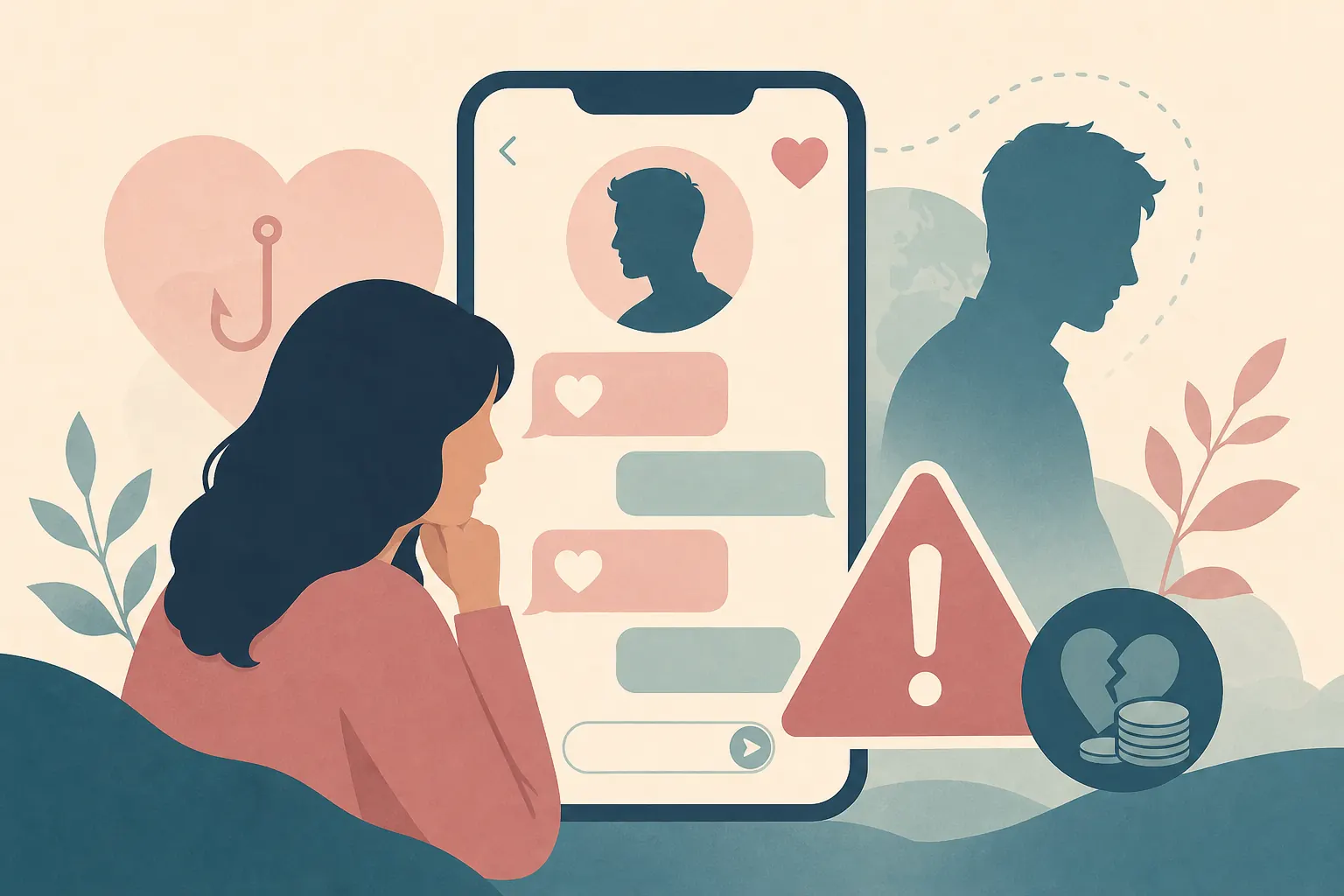
Romance scams are emotional first and financial second. Attackers do not need to hack your laptop. They build a relationship, mirror your hopes, then invent an emergency that only your money can solve. Understanding that pattern matters more than memorizing every new excuse they invent.
These scams succeed because they feel personal. The conversation is warm. The photos look real. The voice notes sound sincere. By the time money enters the chat, many people are already defending the relationship to themselves — which is exactly what the scammer wants.
The usual romance scam timeline
Most online romance scams follow a predictable arc, even when the details change:
- Friendly contact on a dating app, social network, or even email
- Fast emotional intensity (“you’re the only one who understands”)
- Move to private messaging
- Excuses for never meeting or never doing a live video call
- A sudden emergency needing money, crypto, or gift cards
- More requests after the first payment
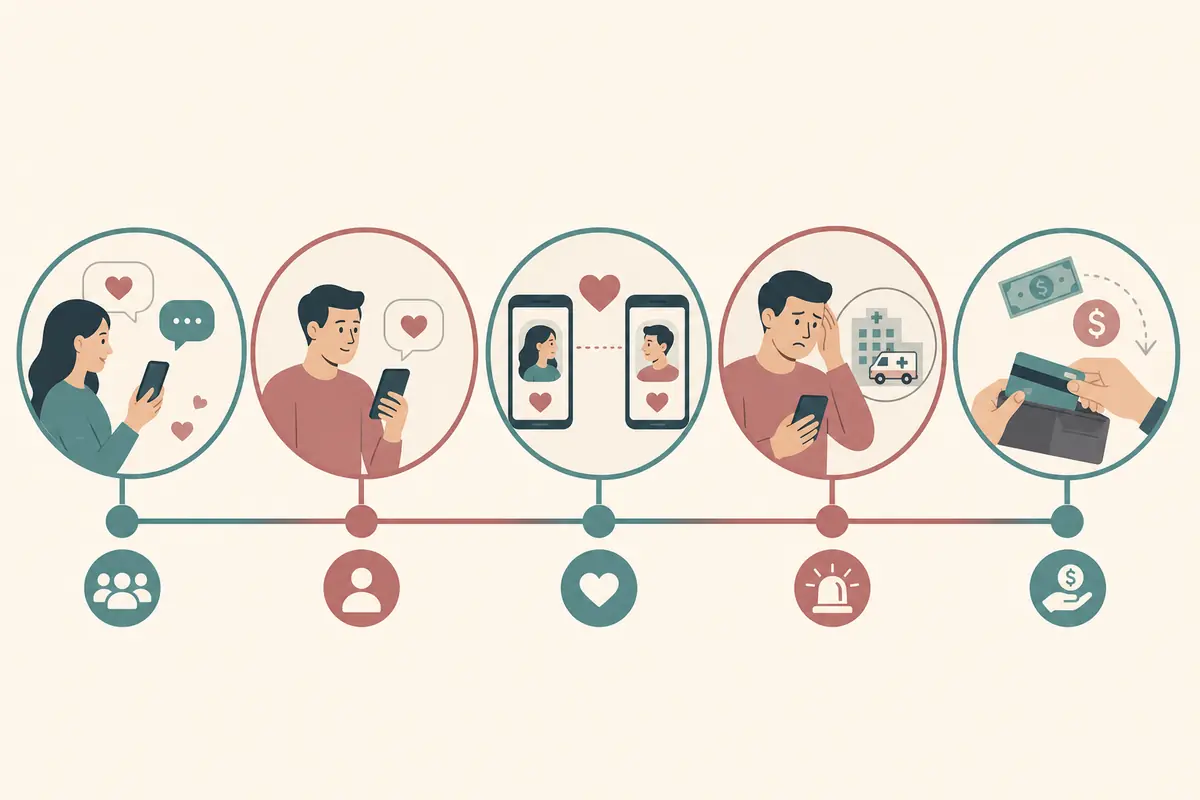
That sixth step is easy to miss. The first transfer is rarely the last. Once you have paid, scammers treat you as a proven source of funds. They may invent travel delays, customs fees, investment “locks,” or legal trouble that only more money can unlock.
How romance scams work under the surface
Social engineering, not romance
A romance scam is a long-form social engineering campaign. The attacker studies what you respond to: loneliness after a breakup, excitement about travel, pride in being helpful, or hope for a second chance at love. They adapt the persona accordingly — military officer overseas, widowed professional, contractor on an oil rig, entrepreneur stuck in a foreign city.
Stolen identities and recycled scripts
Photos are often lifted from real people’s social accounts. Some scammers run multiple chats at once with near-identical scripts. That is why stories can feel polished yet oddly thin on verifiable details: workplace names that do not search well, vague hometowns, and travel plans that never quite land on a calendar date you can check.
Why they push you off the platform
Dating apps and large social networks have reporting tools, message filters, and sometimes payment warnings. Private chat apps give the scammer more control and less oversight. Moving you “somewhere more private” is often framed as intimacy. Functionally, it reduces the chance the platform flags the conversation before money is requested.
The money ask is designed to feel temporary
Scammers rarely say “send me money forever.” They say “loan,” “hold,” “just this once,” or “I’ll repay you Friday.” Temporary framing lowers resistance. Once you have broken your own rule about sending money, the next ask is easier for them to justify.
Red flags to take seriously
- Love declarations extremely early
- Refusal of live video with weak excuses
- Scripted-sounding life stories that avoid verifiable details
- Requests for money, investment “opportunities,” or crypto wallets
- Anger or guilt when you ask questions
- Profiles with stolen photos (reverse-image search can help)
- Sudden travel emergencies involving wire transfers, gift cards, or crypto
- Claims that banks, lawyers, or customs require you to pay on their behalf
- Pressure to keep the relationship secret from friends and family
One red flag alone is not always proof. A cluster of them — especially money plus no live video — is enough reason to pause and get a second opinion from someone you trust in real life.
Common mistakes that make romance scams easier
Treating intensity as proof of sincerity
Fast bonding can feel exciting. Scammers know that. They manufacture urgency in the relationship itself so that later financial urgency feels consistent with the bond you already “share.”
Confusing secrecy with privacy
Wanting a private conversation is normal. Being asked to hide money transfers, hide the relationship, or stop talking to friends about it is different. Isolation removes your best early warning system: people who know you and are not inside the scam’s emotional bubble.
Assuming only “gullible” people get caught
Romance scams are built for intelligent, caring people. Empathy is the feature being exploited. Shame after a loss is also part of the design — it keeps victims quiet and reduces reporting.
Sending a “small test” payment to prove trust
Scammers welcome small payments. A small transfer teaches them your payment method works and trains you to say yes. It is not a trust exercise; it is onboarding.
Believing crypto or gift cards are safer for “emergencies”
Irreversible payment methods are preferred by scammers for a reason. Once crypto or many gift-card transfers clear, recovery options shrink dramatically.
Step-by-step: how to protect yourself
- Keep early chats on the platform with reporting tools
- Insist on a live video call before deep trust
- Never send money to someone you have not met in a verifiable way
- Talk to a trusted friend about the relationship and any money request
- Reverse-search profile photos when something feels off
- Slow the pace on purpose — healthy relationships can survive a pause
- Verify major life claims independently when possible (workplace, location, mutual connections)
- Set a hard personal rule about money before you need it
If someone reacts with rage, tears, or accusations of betrayal when you ask for a video call or refuse a transfer, treat that reaction as data. Real partners may feel disappointed. Scammers often escalate emotional pressure because the money pipeline is closing.
A deeper protection checklist for dating apps and chat
Before you match and message
Use platform safety settings where available. Be cautious with profiles that have almost no history, recycled bios, or photos that look professionally scraped from elsewhere. Be especially careful if the first messages feel generic and could have been sent to anyone.
While trust is building
Prefer video early, even briefly. Ask ordinary questions that require present-tense answers: where are you right now, what did you do today, can we hop on a quick call. Watch whether details stay consistent across days. Save important messages if something starts to feel wrong.
When money appears in the conversation
Stop. Do not negotiate the amount. Do not ask for “proof” documents as a way to keep the relationship going — forged hospital bills and customs letters are common. Talk to a trusted person offline. Report the profile. If you already sent money, move to the recovery steps below instead of sending more to “fix” the first transfer.
What to do if you are already affected
- Contact your bank/payment provider immediately
- Keep chat records and transfer receipts
- Report on the platform and to local authorities where possible
- Be alert for “recovery scams” that offer to get your money back for another fee
- Consider support resources — these scams are designed to create shame
- Secure your accounts if you shared personal data, IDs, or one-time codes
- Tell at least one trusted person what happened so you are not handling follow-up alone
- Watch for new contacts claiming to be investigators, lawyers, or recovery specialists who found your case
If the scammer still has access to your chats, they may try a second act: sympathy, apology, or a new crisis. Ending contact is part of damage control. Reporting is not about embarrassment; it helps platforms and, in some cases, other potential victims.
FAQ
Can romance scams happen to smart people?
Yes. They target emotions and isolation, not intelligence. Education reduces risk, but anyone can be targeted when they are hopeful, grieving, or simply open to connection.
Is asking for a video call rude?
No. It is a normal safety boundary. Anyone serious about meeting you in real life should understand why live verification matters online.
What if they already video called me once?
A single call helps, but it is not a lifetime passport. Deepfakes and replayed clips are evolving risks, and some scams involve hired actors. Ongoing consistency, meeting plans, and zero money pressure still matter.
Why do scammers ask for gift cards or crypto?
Those methods are harder to reverse and easier to move quickly. “The hospital only takes gift cards” or “customs needs Bitcoin” is almost never a legitimate personal emergency story.
Should I confront the person if I suspect a scam?
You can stop sending money and report without a dramatic confrontation. If you do ask direct questions, watch for deflection, guilt, or sudden aggression. Do not send more money to “prove” anything during that conversation.
Can I get my money back?
Sometimes partial recovery is possible if you act fast with your bank or payment provider, especially for certain card or transfer types. Crypto and many gift-card purchases are harder. File reports promptly and keep documentation. Beware anyone who guarantees full recovery for an upfront fee.
What if I shared intimate photos or personal documents?
Preserve evidence, stop contact, and consider platform reporting plus local guidance on image abuse or identity misuse where relevant. Change passwords on related accounts, and do not pay “blackmail” demands promising deletion — payment often leads to more demands.
Key takeaways
Romance scams online succeed by building trust faster than verification can catch up. The move to private chat, the refusal of reliable live contact, and the first “temporary” money request are the core pattern behind most cases. Protect yourself with platform tools, video verification, and a firm no-money rule for people you have only met online. If you already sent funds, act quickly with your bank, keep records, report the profile, and ignore recovery-fee follow-up scams. Caring about someone is not the mistake — paying under pressure before you can verify who they are is the opening attackers rely on.
Was this guide helpful?
Tap like or dislike — one vote per visitor.
Comments
Share a tip or question. Keep it practical — no spam, links farm, or personal data dumps.
- Loading comments…