Education guide
AI Voice Clone Scams: Why That Family Emergency Call Isn’t Real
How AI voice cloning scams fake urgent family calls, how to verify safely with a callback and code word, and what to do if money already moved.
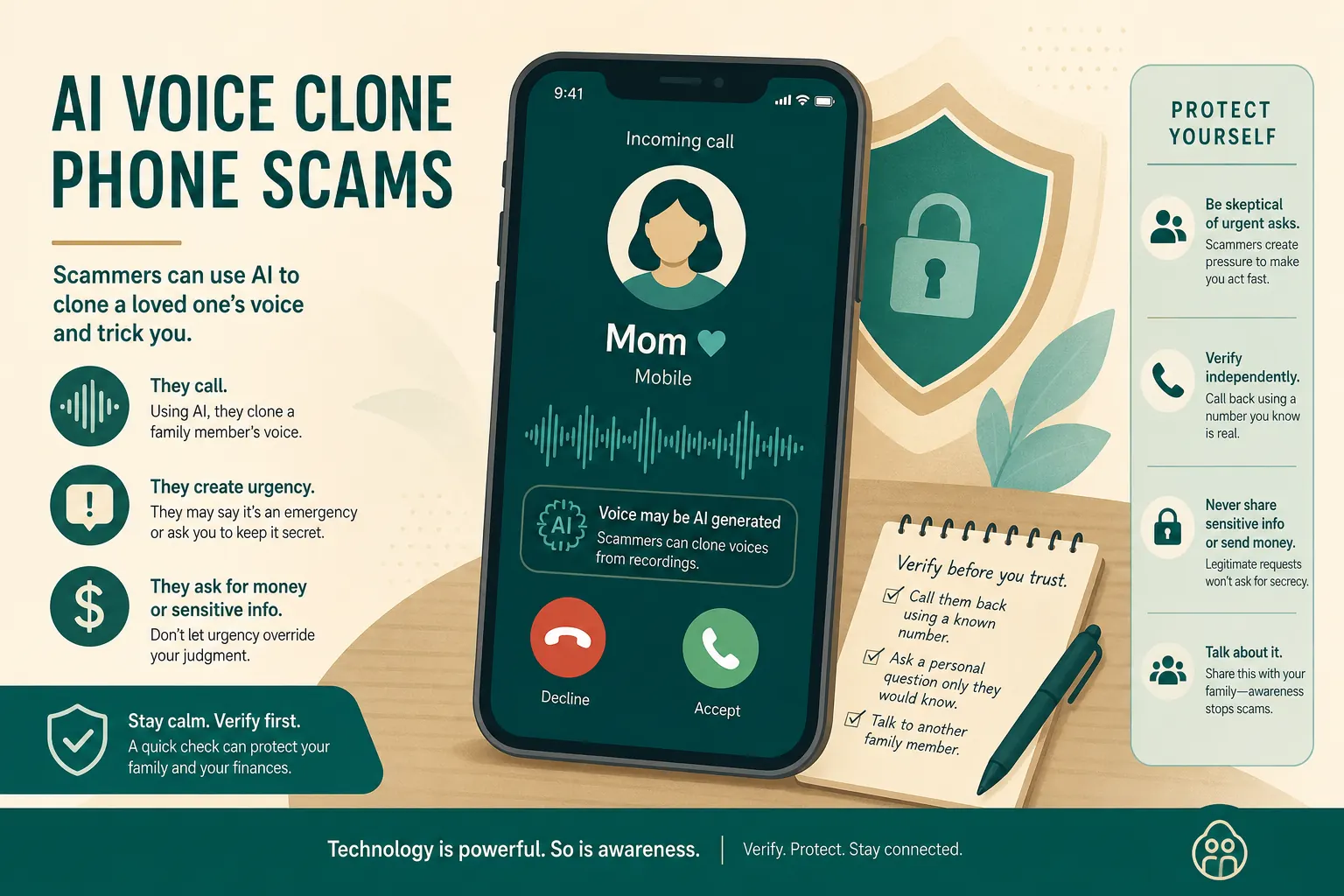
A panicked call starts with a familiar voice: “It’s me — I need help right now.” Your brain fills in the rest before your skepticism can catch up. In AI voice clone scams, attackers can imitate a loved one using short public audio, then push you into an emergency money transfer. The call feels intimate. The request is designed to be too urgent for careful checking.
This guide explains how these scams work, how to slow the moment down, and the practical habits that protect families — especially older relatives. You do not need to become a deepfake expert. You need a verification ritual.
What an AI voice clone scam is trying to do
These attacks are a form of vishing (voice phishing). The goal is usually:
- Emergency wire transfers
- Gift cards or crypto “because cards won’t work”
- Secrecy (“Don’t tell Mom/Dad yet”)
- Fast decisions before anyone else can intervene
Some versions target workplaces too (“CEO needs a urgent payment”). The consumer version often targets family care and panic.
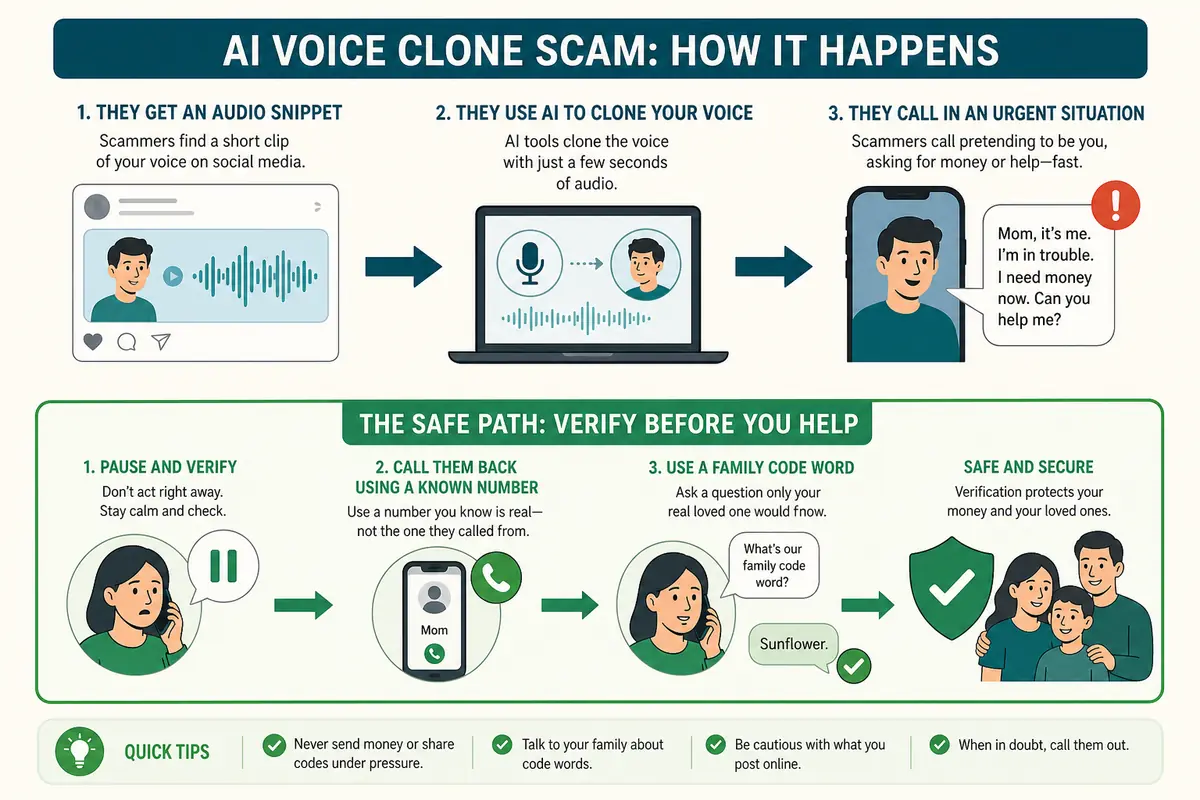
How the scam works step-by-step
- Audio collection — Attackers find voice samples from social media, videos, voicemail greetings, or other public clips.
- Cloning — Tools generate speech that resembles the target.
- Contact — A call or voicemail hits a parent, grandparent, partner, or coworker.
- Story — Arrest, hospital, travel disaster, kidnapped pet, customs fee, or business emergency.
- Pressure — “Only a short window,” “don’t call anyone else,” “I’ll explain later.”
- Payment — Wire, transfer apps, gift cards, or crypto — methods that are hard to reverse.
Why it feels so convincing
Humans are wired to respond to distress in a known voice. Callers exploit that reflex. They also keep talking so you never get a quiet second to think. The technology matters, but the social engineering is still the engine.
Red flags in the call itself
- Unexpected emergency money request
- Pressure to act before you can call anyone else
- “Don’t tell the rest of the family”
- Payment methods that are hard to reverse
- Refusal to switch to a video call or known chat app
- Details that stay vague when you ask specific questions
- A callback number that is “for the lawyer/hospital” instead of the person
Human tip: ask one private question
Agree ahead of time on something only your family would answer quickly:
- A childhood pet nickname
- The street where you lived in a certain year
- A shared nonsense code word
A cloned voice can sound right and still fail the shared secret.
The family verification ritual (teach this once)
Practice this when everyone is calm:
- Hang up politely if needed.
- Call back using a number already saved in your contacts — not a number from the urgent call.
- Ask for the code word or private question.
- Only then discuss money, travel, or legal help.
- If you cannot reach them, contact another trusted family member before sending anything.
What to say in the moment
You can keep it kind and firm:
- “I want to help. I’m going to call you back on your saved number.”
- “Tell me our family code word.”
- “I don’t send money from a surprise call.”
If the caller becomes angry, that is useful information. Anger is often part of the script.
How this differs from ordinary phone scams
Classic tech-support or IRS-style calls often use generic “official” voices. Voice-clone scams borrow your family’s emotional trust. That is why callbacks and code words matter more than “detecting robotic audio.” Audio quality will keep improving. Rituals still work.
Related reading: if the pressure is about codes instead of cash, see OTP scams explained. If the call turns into remote-access computer help, see fake tech support scams.
Common mistakes that make voice-clone scams succeed
- Believing caller ID or “saved contact” spoofing without a callback
- Sending money while still on the first call
- Keeping the emergency secret from everyone else
- Using gift cards or crypto because the caller “can’t use a normal bank”
- Skipping the code word because the voice “sounds exactly right”
- Calling back a number the urgent caller just dictated
The scam wants speed and isolation. Your defense is the opposite: slow down and bring in a second channel.
Extra human tips for families
- Practice the callback once when nothing is wrong. Muscle memory beats panic.
- Put the code word in a sealed note near the phone for older relatives if memory is an issue — still better than trusting a surprise voice.
- If you are the “emergency voice” in the family (student living away, frequent traveler), tell relatives in advance that you will never ask for secret money transfers by phone alone.
- For group chats, agree that money emergencies require a video confirmation and a callback, not one channel alone.
Practical habits that reduce risk
- Limit public videos where a clear solo voice is easy to sample
- Review privacy settings on social posts
- Warn relatives that AI can imitate voices now
- Keep a written list of official bank fraud numbers
- Prefer bank apps and known processes over phone instructions from a stranger claiming to be family
- For business payments, require a second channel approval
Workplace version in plain language
A caller sounds like a manager: “Need a vendor paid in the next ten minutes. I’ll explain after the meeting.” Finance staff are trained to be helpful. Helpful is good — unreviewed wire transfers are not. Require a second approval in email or chat from a known account, not instructions that exist only on one urgent call.
If money already moved
Move quickly:
- Contact your bank or transfer service immediately and report fraud
- Save call logs, voicemails, texts, and payment receipts
- File a report with local police when appropriate
- Report through consumer fraud channels (such as FTC tools) and IC3 when relevant
- Tell nearby family so the same script does not hit someone else the same day
- Watch for follow-up calls pretending to “help recover” the money — recovery scams are common
Emotional recovery matters too
These scams create shame on purpose. Shame keeps people quiet, which helps attackers. If this happened to you or someone you love, focus on stopping further loss first. Judgment can wait.
Longer FAQ
How much audio do scammers need?
It varies by tool and quality, but public clips can be enough. Do not assume you are safe because you “barely post.”
Can I trust a video call instead?
Video can help, but deepfake video is also evolving. The strongest consumer control is still out-of-band verification: call back on a known number and use a shared secret.
What if the caller says they changed phones?
That is a common excuse. Still call the old saved number or reach another family member first.
Are workplaces targeted too?
Yes. “Urgent CEO payment” voice scams exist. Businesses should require dual approval for unexpected transfers.
Should I confront the caller?
You do not need a debate. Hang up and verify. Your job is protection, not catching them mid-call.
Is this only a risk for older adults?
No. Anyone who cares about family can be targeted. Older adults are often hit because attackers expect faster compliance and larger available savings.
Key takeaways
- AI can imitate voices well enough to trigger panic.
- Emergency + secrecy + irreversible payment is a classic scam shape.
- Hang up and call a saved number.
- Use a family code word or private question.
- Teach the ritual before anyone needs it.
- If money moved, contact the bank immediately and report the fraud.
Was this guide helpful?
Tap like or dislike — one vote per visitor.
Comments
Share a tip or question. Keep it practical — no spam, links farm, or personal data dumps.
- Loading comments…