Texts and packages
46339 Text Message: FedEx Delivery Scam or Real? (2026 Guide)
Got a 46339 text message or FedEx delivery SMS? Learn what 46339 means, does FedEx send texts, fake missed-delivery scams, and how to verify tracking safely.
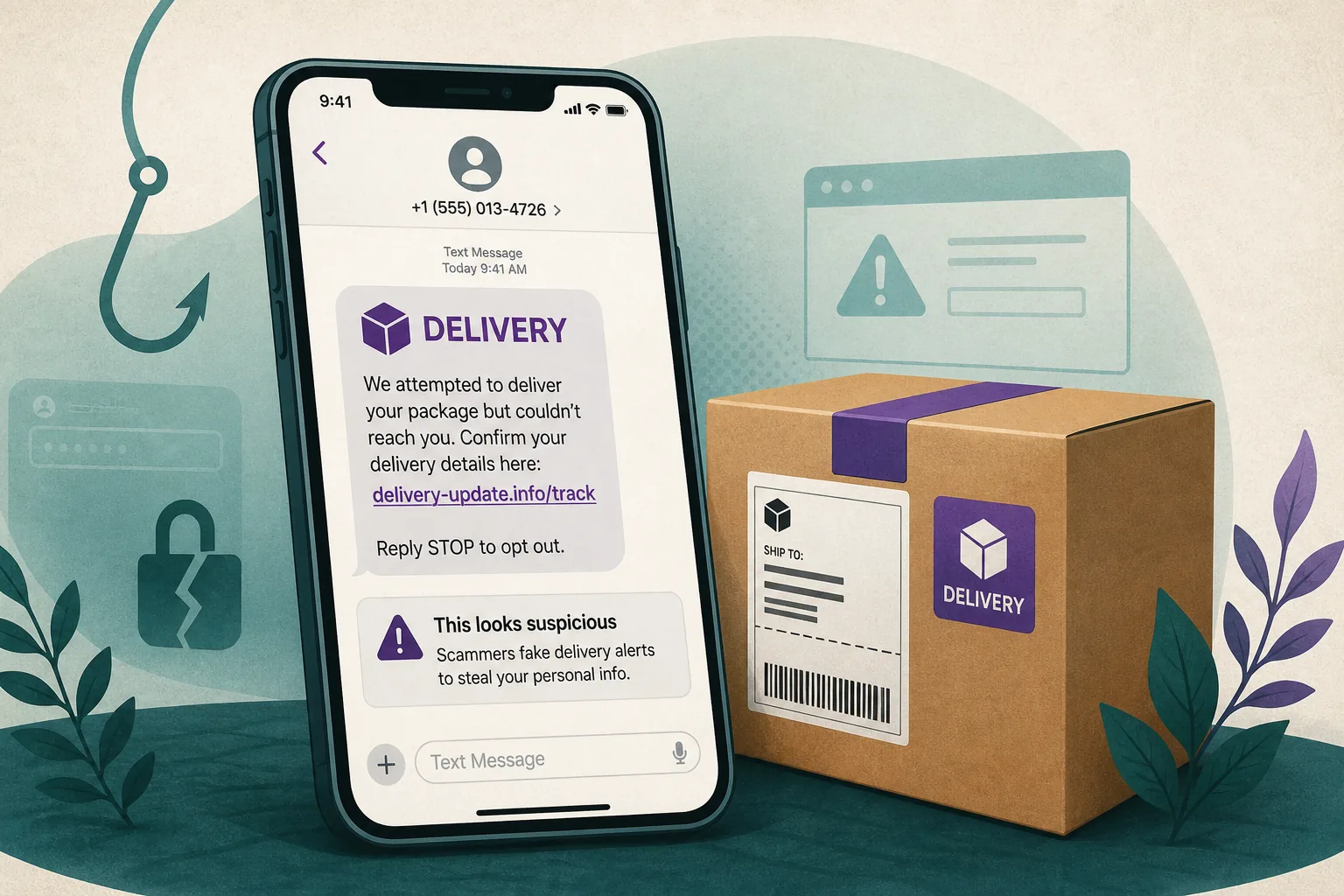
Short answer: A surprise FedEx delivery text scam — including many 46339 text message alerts about a missed delivery, hold fee, address confirmation, or “reschedule now” link — is often fake even if you are waiting on a real package. What number does FedEx text from? Short code 46339 is widely tied to FedEx alert programs, but a familiar code is not a hall pass to tap pay/login links. Do not tap. Check the retailer order first, then verify on FedEx tracking you open yourself.
Your thumb is already halfway to the link. The SMS says FedEx missed you, the package goes back tonight, confirm the address, pay a tiny hold fee — whatever flavor arrives. That spike of “I need that box” is the whole product. The scam does not need a perfect logo. It needs you moving faster than your doubt.
This guide is long on purpose. Delivery smishing wins on speed and half-remembered “facts” (“FedEx never texts,” “short codes are always safe,” “I have a package so this must be mine”). We will tear those myths apart, walk through what a real FedEx delivery notification text looks like in practice, explain 46339 and FedEx Delivery Manager, show the minute-by-minute trap, and give you a household routine you can reuse for DHL, UPS, and USPS clones too.
Myth → truth (the beliefs that make people tap)
Myth: “If it says FedEx, FedEx sent it.”
Truth: Anyone can type the word FedEx. Brand names in SMS are costumes. Real status lives on the official site or app you open — not inside a stranger’s message. Call ID labels and purple-looking headers are equally easy to fake or misread on a small screen.
Myth: “FedEx never texts, so every delivery text is fake.”
Truth: FedEx can send a FedEx delivery notification text when you opt in — for example through FedEx Delivery Manager SMS alerts, or SMS tracking you started yourself. Cold fee-and-link texts are the problem, not the idea of SMS itself. The useful question is not “does FedEx text?” It is “did I ask for this channel, and does official tracking agree?”
Myth: “A missed-delivery text must be urgent or I lose the package.”
Truth: “Missed you / failed attempt / return today” is the favorite FedEx fake delivery attempt script because it manufactures a deadline. Real exceptions still show up when you check tracking from FedEx.com or the retailer. Carriers and sellers have processes that do not require a panic tap from an unknown SMS.
Myth: “If the number is 46339, I’m safe.”
Truth: People search what number does FedEx text from and FedEx text number 46339 for a reason — that short code is widely tied to FedEx alert programs. Scammers still win with lookalike pages, spoofed senders, and ordinary mobile numbers. A familiar code is a clue, not a hall pass to pay or log in. Never treat a number as a password to your wallet.
Myth: “HTTPS and a clean page mean it’s legit.”
Truth: Fake tracking pages encrypt traffic too. Pretty design is not identity. Padlocks stop eavesdroppers on the wire; they do not prove you reached FedEx.
Myth: “Reddit said this exact wording is real / fake, so I’m done.”
Truth: Threads about a FedEx delivery text message help you spot patterns — weird domains, fee language, screenshot galleries. They do not replace opening your own order and official tracking. Screenshots age; domains rotate; comment sections get wrong answers mixed with good ones.
Myth: “I ordered something this week, so the text is probably about my order.”
Truth: Timing is part of the spray. Scammers send broadly during shopping seasons and quiet Tuesdays alike. Your brain connects the dots. Verification disconnects them.
Myth: “A few dollars to release the package is harmless.”
Truth: Small amounts lower your guard and confirm a working card. The fee is the door; the data is the house.
Do this now (under two minutes)
- Hands off the link in the FedEx delivery text message.
- Retailer first — open the store/app where you ordered.
- FedEx second — type fedex.com or use the official app; paste the tracking number from the order, not from the SMS, when you can.
- No match? Report junk / forward to 7726 (US), delete, move on.
- Already typed a card or password? Jump to the damage-control section — bank and password resets beat rereading the text.
That sequence is the spine. The rest of this article is why people skip it — and how to stop skipping it.
Why this bait feels personal
Online shopping trains you to expect interruptions: weather delays, apartment gates, “recipient not available,” porch theft fears. A FedEx delivery notification text borrows that muscle memory. You are not weak for feeling the spike. The message is engineered for it.
Scammers do not always need your exact tracking number. A wide spray plus “you’re waiting on something anyway” is enough. Some campaigns get more specific with partial addresses or order-ish language scraped from leaks, forms, or prior phishing. Specificity raises confidence; it does not raise legitimacy.
What they want after the tap:
- A small “redelivery,” “address correction,” “storage,” or “customs” payment
- Login fields dressed as Delivery Manager or “secure tracking”
- Name, address, phone, date of birth style fields for later fraud
- Sometimes a second act: “refund agent,” fake support chat, more fees
- Occasional malware or intrusive app installs on rushed phones
Minute-by-minute: how a fake FedEx SMS usually unfolds
Not a textbook checklist. A day-in-the-life of the trap:
Morning. You ordered something last week. You barely remember whether it was FedEx, UPS, or “whatever the seller uses.”
Afternoon. Phone buzzes. SMS claims a delivery attempt failed, the address is wrong, a hold fee is due, or you must “manage delivery” before return-to-sender.
The hook. One tap “fixes” it before you get home from work. The message writes the clock for you.
The page. Looks like tracking or FedEx Delivery Manager. Sometimes it mirrors colors and button shapes you have seen in real apps. Sometimes it is sloppy. Both styles convert.
The ask. Card number. “Confirm identity.” Sometimes an OTP that also unlocks email or banking if you reuse habits badly.
The quiet after. Unauthorized charges — or a caller who already knows your address and claims to be “FedEx fraud prevention” (another costume).
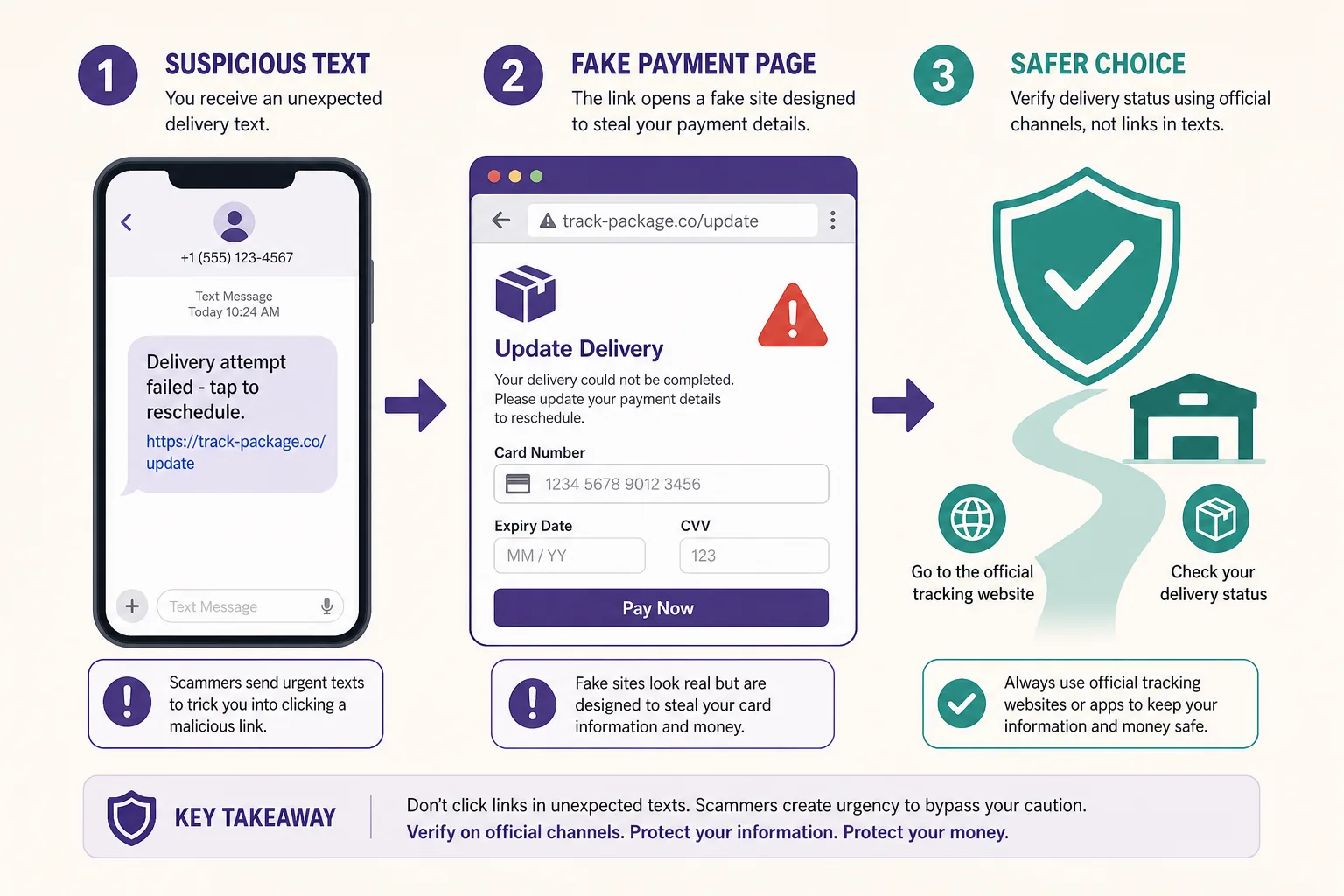
Same engine with a DHL, UPS, USPS, or Amazon sticker. Different paint, same trap. Deeper siblings on BreakTheBait:
What the text usually claims (wording patterns)
You will see variations of:
- Delivery attempt failed / missed you
- Address incomplete — confirm now
- Package on hold — pay storage or redelivery
- Customs / duties / postage due (even for domestic orders)
- “Update delivery preferences” / “manage your shipment”
- Out for delivery — click to enable signature or leave permission
- Suspicious activity on your shipment — verify identity
Notice the common structure: problem you did not ask for + short deadline + link as the only offered fix. Real shipping problems can almost always be checked without that link.
“Does FedEx send text messages?” — the honest middle
Yes, when you set that up. No blank check for every SMS that mentions purple branding.
When a FedEx delivery notification text can be real
- You enrolled in SMS alerts through official FedEx tools such as FedEx Delivery Manager preferences.
- You started SMS tracking yourself for a specific tracking number through FedEx’s published process.
- The message is status-oriented (scheduled, out for delivery, delivered) and still matches what you see when you open tracking yourself.
When to treat it as scam-first
- You never opted in and never texted FedEx to follow a number.
- The SMS demands money, a password, SSN-like data, or a rush tap.
- The only “proof” is the message itself.
- Official tracking and your retailer show no matching problem.
Gut-check questions
- Did I enroll in alerts or start SMS tracking on purpose?
- Does this SMS demand money, a password, or a frantic tap?
- Can I see the same problem on FedEx tracking or my retailer without the SMS link?
If #3 is “no problem exists,” you are not looking at a real missed delivery. You are looking at theater.
What number does FedEx text from? (and what about 46339?)
Search interest around FedEx text number 46339 is huge because short codes feel “official.” In public short-code records and consumer guidance, 46339 is widely associated with FedEx product/delivery alert programs. That does not mean:
- every message that claims to be 46339 is safe to click through, or
- every legitimate-looking short code style message should collect your card, or
- scammers cannot use ordinary 10-digit numbers, email-to-text gateways, or spoofed labels instead.
Practical rule: treat the sender ID as a weak signal. Treat independent tracking as a strong signal. If you want to manage real FedEx SMS preferences, do it while logged into FedEx on a site or app you opened yourself — not from a surprise fee link.
FedEx Delivery Manager — what it is (and what it is not)
FedEx Delivery Manager is FedEx’s real recipient toolset for viewing and managing eligible residential deliveries, including notification options when you enroll. Scammers love borrowing the name because it sounds like a dashboard you “should” already have.
What Delivery Manager is not:
- A reason to enter your card into a random SMS landing page
- A pop-up that only exists inside a shortened link
- A phone number that called you first demanding remote access
If you need Delivery Manager style controls, start at FedEx.com and navigate from there. Bookmark the real entry points you use often.
Real vs fake side-by-side (when you need a quick compare)
| Signal | Fake FedEx text scam | More likely legitimate |
|---|---|---|
| Start | Surprise SMS while you may or may not have a package | Alert you opted into, or tracking you started |
| Pressure | Confirm/pay/return-today language | Status update you can re-check on FedEx.com |
| Link | Shortener, misspelling, “secure-delivery” clone | You type fedex.com / use official app |
| Ask | Card, login, “release fee” | No need to pay a stranger from SMS to free a normal parcel |
| Sender | Random mobiles, odd labels | May involve known alert short-code patterns such as discussions of 46339 — still verify |
Soft red flags people overlook
- The text arrives the same week as a real order (coincidence is design).
- The page uses HTTPS and looks “corporate.”
- The grammar is perfect (modern kits are polished).
- A friend forwarded the same text (spray campaigns hit many phones).
- It mentions your city or apartment buzzwords.
- It tells you not to “delay verification.” That sentence is the tell.
A reusable household / workplace ritual
Teach this once; reuse forever:
- Announce: “Got a carrier text — pausing.”
- Split roles if helpful: one person holds the phone (no tap); another opens the retailer on a second device.
- Compare: order status vs SMS claim.
- Confirm: official carrier tracking from a typed URL or official app.
- Close: delete/report, or act only from the official portal.
- Share the win: tell the household what the bait tried so the next person is faster.
This ritual works for FedEx, USPS, Amazon QR cards, toll texts, and “account locked” alerts. Same pause muscle, different costumes.
Common mistakes that keep the scam profitable
- Tapping “just to see.” Previewing a phishing page still trains urgency and can load tracking scripts.
- Paying a small fee to “be safe.”
- Reusing the same password on the fake “Delivery Manager” login.
- Calling a number printed inside the suspicious SMS.
- Arguing with the scammer for a refund inside the chat. Preserve evidence; use your bank.
- Ignoring follow-up recovery scams after the first loss.
If you already clicked or paid
Speed over shame.
- Stop. Do not “finish” the form.
- Call the bank/card issuer if payment details went in; ask about unauthorized charges and card replacement.
- Change any password you typed; enable two-factor authentication.
- Review email forwarding rules and recovery phone/email if you exposed an inbox login.
- Ignore anyone who messages next offering recovery for a fee — see also fake FBI IC3 recovery scam patterns.
- Report the SMS (US: forward to 7726); report fraud through the FTC.
- Full first-day map: What to Do If You Already Paid a Scammer.
Document screenshots of the SMS, the URL bar if you still have it, and any confirmation emails. That paperwork helps disputes.
Lookalike brands: same bait, new sticker
If the logo says DHL, UPS, USPS, OnTrac, Lasership, or a regional courier:
- Do not invent a new panic rule.
- Apply the same retailer-first, official-site-second sequence.
- For UPS short codes 75137 and 24031, use the dedicated UPS 75137 guide.
- Be extra careful with QR stickers on packages — they are just links you cannot read until too late (Amazon package QR guide).
- Fake “courier fee” texts also show up after Facebook Marketplace “shipping only” deals — same verify-yourself rule.
Postal and parcel fraud is a category. The carrier name is marketing for the criminal.
Quick answers
FAQ
10 questions
Opt in status texts can be real. Unexpected fee/link texts are usually fake. Verify on FedEx.com / your retailer, not inside the message.
Trusted sources
- FedEx official site
- FedEx tracking
- Report fraud to the FTC
- FTC: how to recognize and report spam texts
- CISA: phishing guidance
Key takeaways
- The scam sells panic about a box — not accurate shipping news.
- Myths (“brand = real,” “46339 = safe,” “pretty page = safe,” “I ordered so it’s mine”) are how taps happen.
- Opt-in FedEx texts can be real; unexpected pay/confirm links usually are not.
- Retailer + official tracking beat any SMS.
- Learn Delivery Manager and 46339 as concepts — not as excuses to skip verification.
- Same rules for DHL/UPS/USPS clones.
- Already paid? Bank first, ego later. Watch for recovery scams second.
Was this guide helpful?
Tap like or dislike — one vote per visitor.
Comments
Share a tip or question. Keep it practical — no spam, links farm, or personal data dumps.
- Loading comments…