Education guide
DMV Text Scam (2026): Is That Overdue Traffic Ticket Message Real?
How DMV text scams and overdue traffic ticket texts work, the red flags that expose them, and what to do if you already clicked or paid.
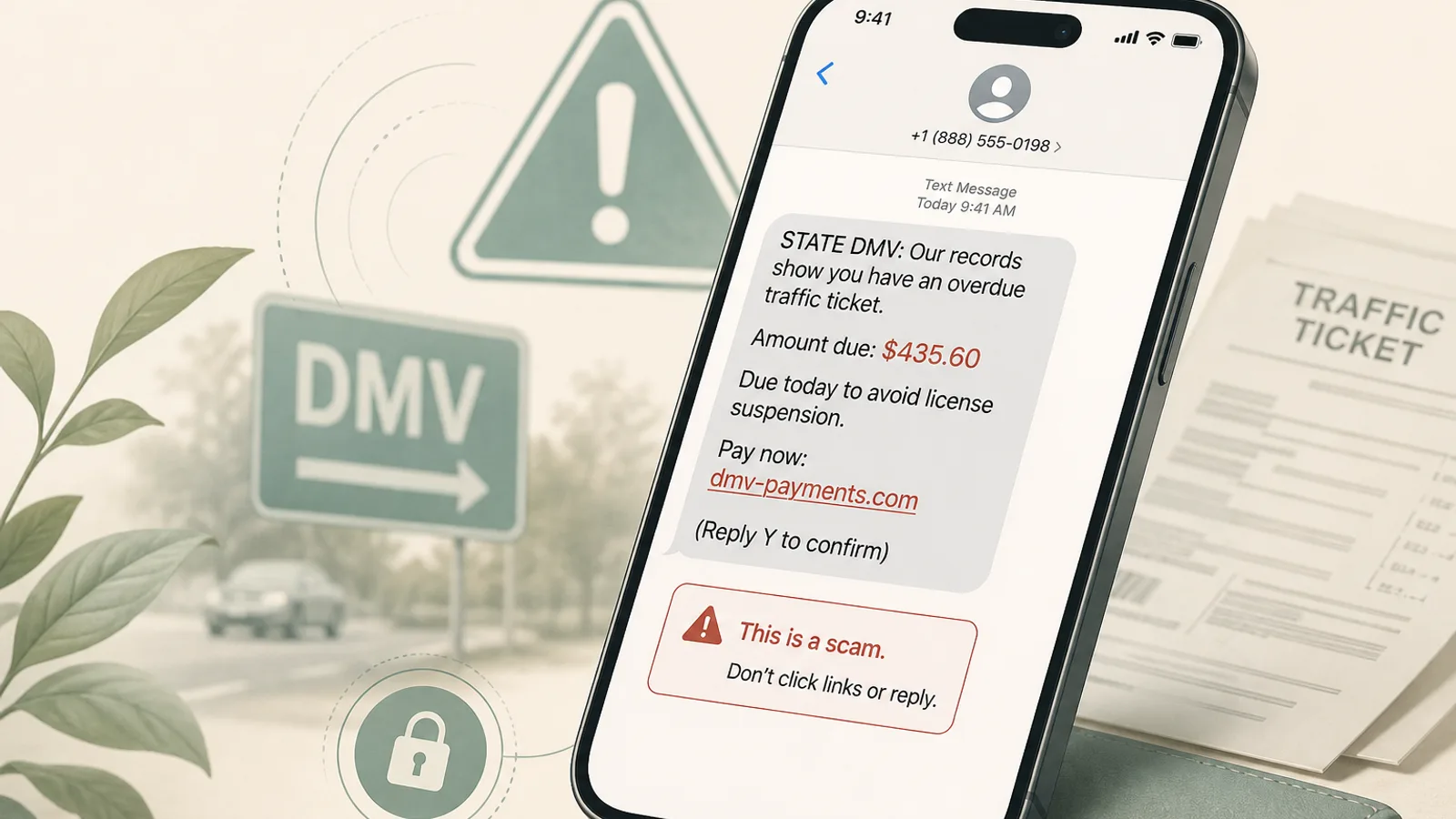
Your phone lights up with a message that sounds official: “Final notice. You have an overdue traffic ticket. Pay now to avoid license suspension.” The wording is stiff. The deadline is tight. The consequence feels serious. That is exactly why DMV text scams work. They are built to make responsible people panic before they verify.
This guide explains how fake DMV and traffic-ticket texts work, how to spot the red flags, and what to do if you already tapped the link. You do not need to become an expert in motor-vehicle bureaucracy. You need a routine that works when your nerves do not.
What a DMV text scam is trying to do
These messages are usually not about a real traffic ticket. They are about getting you onto a fake payment page quickly enough to collect:
- Card details
- Name, address, and phone number
- Driver's license or vehicle information
- Enough personal data for identity misuse or follow-up fraud
The scam works because the topic feels believable. Most adults have some relationship with a DMV, traffic authority, court, or registration office. That built-in familiarity does half the attacker's work for them.
How the scam works step-by-step
- Unexpected text - You receive a message claiming to be from DMV, DOT, traffic enforcement, or a court-linked system.
- Pressure - The message says you have an overdue ticket, violation, or fine.
- Threat - It warns about suspension, extra penalties, court action, or credit damage.
- Link - A payment URL or QR code sends you to a fake page.
- Capture - You enter personal and payment details.
- Follow-up abuse - Attackers charge the card, reuse the data, or target you again.
Some variants use phrases like “DMV violation database,” “final notice,” or “35% service fee” to sound official. Others copy seals, state abbreviations, or department names. Fancy wording does not make the message real.
Common forms of the message
DMV-related scam texts often appear as:
- Overdue traffic ticket alerts
- License or registration suspension warnings
- “Immediate action required” notices
- Municipal court payment texts
- Parking or toll fine combinations
- QR codes that lead to a payment portal
Some scams blend DMV language with toll scams because people already know toll notices are a real thing. The attacker only needs the story to feel plausible for one minute.
Red flags in the text itself
Look for these signs:
- A link in an unsolicited text
- Threats of immediate suspension or legal trouble
- Requests to pay “today” or “within hours”
- Strange domains, random numbers, or extra hyphens
- Generic greetings instead of a real official notice process
- Pressure to reply or confirm by text
- A fee that looks small enough to pay without thinking
- References to agencies you do not normally deal with by text
Human clue that matters
Real government processes are annoying, but they are usually not this rushed. They do not depend on your ability to tap a random SMS link in a parking lot, during lunch, or while half-distracted at work.
What real DMV or court communication usually looks like
Legitimate issues are more commonly handled through:
- Official mail
- Secure logins on the real agency website
- In-person notices
- Phone numbers published on the official agency site
- Email or text alerts only if you already opted in for them
Even when an agency offers account alerts, that still does not mean you should trust a surprise payment link in a text. The safe habit stays the same: open the official site or app yourself.
Why responsible people still fall for this
These scams are not just targeting careless people. They are targeting:
- drivers who recently renewed registration
- parents juggling too many tasks
- commuters who have used toll roads or city parking
- anyone who worries about official paperwork
The message works because it uses authority and urgency together. Your brain hears, “This sounds serious. I should fix it now.” The scammer wants your first reaction. Your safety depends on your second one.
A 30-second verification routine
Use this checklist:
- Did this come out of nowhere?
- Does it ask me to pay from the message itself?
- Is the threat bigger than the fee?
- Can I verify the same issue from the official state or court website without using the link?
- Would a real agency lose all patience if I checked independently first?
If the answer feels off, stop there.
Common mistakes that make DMV scam texts succeed
- Tapping first and planning to “just look”
- Assuming the message must be real because it mentions suspension
- Paying a small amount to avoid stress
- Calling a number included in the scam text
- Trusting a polished payment page
- Thinking HTTPS means the site is legitimate
- Entering license information “just to see the violation”
The scam does not need a perfect victim. It needs one rushed moment.
Good practical tips
- Save your actual state DMV website in bookmarks.
- If you use a state app, open it from your phone home screen, not from a text.
- Keep a family rule: no payments from surprise messages.
- If a relative sends you a scary DMV text for advice, tell them to close it before discussing it.
Step-by-step: what to do with a suspicious DMV text
- Do not tap the link or scan the QR code.
- Do not reply. Replies can confirm your number is active.
- Open the official agency site yourself using search, a bookmark, or a known app.
- Check your real status there.
- Report the message as junk on your phone or forward it to 7726 where supported.
- Delete the text after reporting it.
- Warn family members, especially people who tend to react fast to official-looking messages.
What to do if you already clicked
If you opened the fake site but did not submit anything:
- Close the page
- Clear the tab
- Do not continue exploring it
- Check your device for any suspicious downloads if the site prompted one
If you entered personal or card details:
- Contact your bank or card issuer immediately
- Ask them to watch for fraud or replace the card if needed
- Change passwords if you typed credentials anywhere
- Watch for follow-up texts pretending to “correct” the first payment
- Consider fraud alerts or stronger identity-protection steps if you shared sensitive ID information
- Report the scam through consumer fraud channels such as the FTC, and IC3 when appropriate
Related scams that look similar
Fake DMV texts often overlap with:
- toll-payment scams
- parking-fine scams
- municipal court texts
- fake jury-duty payment demands
The channel changes a little. The psychology does not. Threat + urgency + link = pause.
If you want to learn the toll version of the same pattern, read Toll Text Scams and EZ Pass Scams. For suspicious websites in general, see How to Tell If a Website Is Safe.
Longer FAQ
Does the DMV send text messages about overdue tickets?
Some agencies may send account alerts if you opted in, but unsolicited payment-demand texts with links are a major red flag. Verify on the official site directly.
Can my license really be suspended over text?
A text may mention suspension, but that does not make it real. Serious actions are handled through formal processes, not panic links from unknown senders.
The message used my state name. Doesn't that make it legitimate?
No. Scammers tailor messages by state because that increases believability.
What if I actually do have an unpaid ticket somewhere?
That is exactly why you should check through the official court or DMV website you open yourself, not the text.
Should I reply STOP?
With scams, reporting and deleting is usually better than engaging. Replies can confirm your number is active.
The page had a lock icon. Was it safe?
No. A padlock or HTTPS only means the connection is encrypted to that site. Scam sites can use HTTPS too.
Could this lead to identity theft and not just card fraud?
Yes. If the page asked for driver's license data, address, phone number, or date of birth, think beyond the card and watch for broader misuse.
Key takeaways
- DMV text scams rely on fear, authority, and urgency.
- The message is usually about stealing data, not collecting a real fine.
- Do not pay or verify through the link in the text.
- Open the official DMV, court, or state site yourself.
- Report junk texts and warn people around you.
- If you already submitted details, contact your bank fast and monitor for fraud.
Was this guide helpful?
Tap like or dislike — one vote per visitor.
Comments
Share a tip or question. Keep it practical — no spam, links farm, or personal data dumps.
- Loading comments…